
Latent Defects and Vendor Liability: Lessons from Austin v. MacFarlane

Picture of Peter Reinitzer

Peter Reinitzer

Peter is a partner at Davidson Cahill Morrison LLP. A fearless advocate, Peter uses a combination of trial advocacy and creative alternative dispute resolution techniques to help his clients achieve their desired outcomes. Peter frequently attends at the Superior Court of Justice and the Court of Appeal where he has successfully litigated numerous trials and appeals. He has also successfully resolved countless disputes by way of mediated settlement.
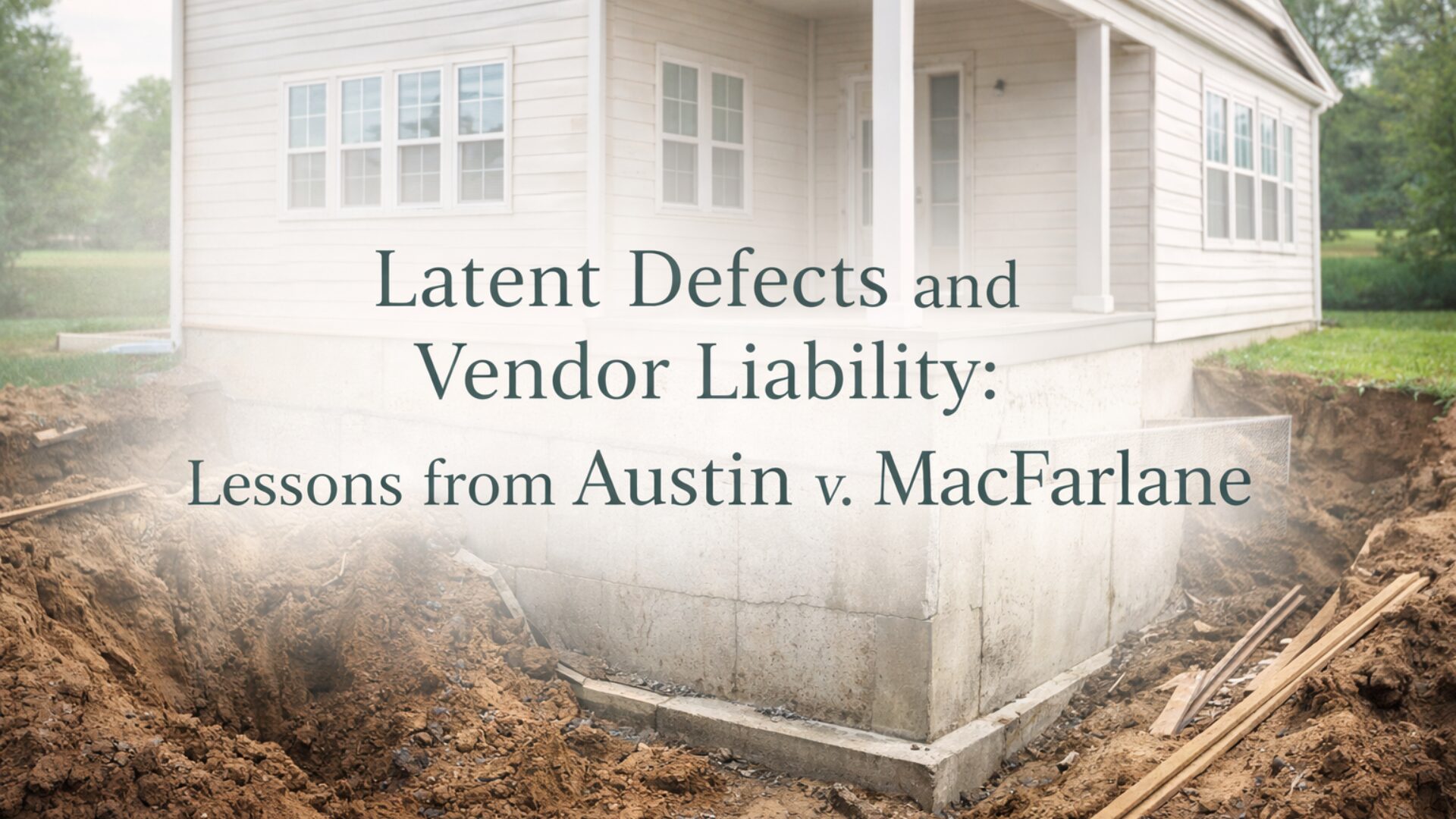
Latent Defects and Vendor Liability: Lessons from Austin v. MacFarlane

In the recent decision of Austin v. MacFarlane, 2026 ONSC 463, the Ontario Superior Court of Justice addressed the ongoing tension between a vendor’s silence and the active concealment of property defects. For litigation counsel and homeowners facing foundation issues, the case serves as a focused reminder: while a purchaser has a duty to carry out reasonable inspections, a vendor cannot rely on the “buyer beware” principle if they have taken steps to hide the true condition of a home.

The Discovery of Latent Defects

The dispute arose following the May 2019 purchase of a residence in North Bay. The plaintiff, Dale Robert Austin, completed a home inspection in January 2019, which identified only minor electrical and window issues. However, just two days after taking possession, water infiltration began seeping through the basement flooring when a piano was moved into the recreation room.

Subsequent investigations by a contractor and a structural engineer revealed:

  • Significant foundation cracks on the north side of the structure.
  • Extensive mould growth behind basement walls.
  • Structural issues related to an improperly constructed and attached deck.

The resulting foundation repairs required excavating the exterior, jacking the house, and extensive repairs of the foundation wall with total property damage costs exceeding $119,000.

Establishing Liability: The Vendor’s Knowledge

The core of the litigation centered on whether the vendor was aware of these issues prior to the sale. The defendant denied all knowledge of water damage or foundation cracks, asserting that any work performed during her ten-year residency was strictly cosmetic.

However, physical evidence contradicted this narrative. Several pieces of drywall removed from the damaged basement walls bore manufacturer date stamps from 2015 and 2017. These stamps provided objective proof that significant basement renovations had been conducted during the defendant’s ownership—repairs that the defendant had not fully disclosed and that served to mask the underlying water damage.

Negligent Misrepresentation

Justice Bellows applied the five-part test for negligent misrepresentation established in Queen v. Cognos Inc.:

  1. Duty of Care: A “special relationship” exists between a vendor and a purchaser in a real estate transaction.
  2. Untrue Representation: The MLS listing described the home as “very well maintained” and in “move-in condition,” which was inaccurate given the structural state of the foundation.
  3. Negligence: The court found the defendant was, at a minimum, willfully blind to the water issues while performing “touch-up” painting on water-damaged baseboards.
  4. Reasonable Reliance: The plaintiff acted responsibly by hiring a home inspector and was entitled to rely on the vendor’s warranties.
  5. Detriment: The reliance resulted in the purchase of a home requiring immediate, massive structural remediation.

Reliance on Precedent: Wesley v. Geneau

Of particular interest to our firm is the court’s reliance on Wesley v. Geneau, 2020 ONSC 868, a case in which we successfully represented the plaintiff. Justice Bellows relied on the Wesley precedent to reinforce several key legal points:

  • Obstruction of Inspection: Similar to Wesley, the defects in the foundation wall were latent because they were hidden from view by stud walls and an obstructed view under the deck.
  • Due Diligence: The court noted that, as in Wesley, the defendant led no evidence to suggest the plaintiff or the home inspector failed to exercise due diligence or inspected negligently.
  • Defining Latent Defects: The court cited Wesley to clarify that latent defects are those not discoverable by any means open to the purchaser before entering the contract.
  • Limitations of Home Inspections: Justice Bellows adopted the reasoning from Wesley that a home inspection report is not intended to find latent defects and cannot be used by a vendor to absolve themselves of liability for misrepresentation.

Quantification of Damages

The court awarded the full cost of repairs, totaling $119,595.75. Notably, the court applied the “private insurance exception” (aka the “Bradburn rule”), ruling that the insurance funds the plaintiff received to cover some of the repairs did not reduce the amount for which the defendant was liable.

Additionally, the court awarded $10,000 in general damages for mental stress and inconvenience. While the plaintiff had sought $100,000, the court noted that there was insufficient evidence to support his claim. However, the “unrelenting” nature of the six-month construction period justified a moderate award for the impact on the plaintiff’s quality of life.

Key Takeaways for Property Owners and Counsel

  • Objective Evidence is Paramount: In credibility contests, manufacturer stamps and mismatched studs can provide the necessary proof of prior repairs.
  • MLS Listings Carry Legal Weight: A vendor’s description of a property as “well-maintained” or “move-in ready” in an MLS listing may amount to actionable representations. If the vendor is aware of, or willfully blind to, latent defects that contradict these claims, they can be held liable for the resulting damages once the purchaser’s reliance is proven.
  • The Wesley Standard: The continued application of Wesley v. Geneau underscores that Ontario courts will not penalize a purchaser for failing to discover defects that the vendor has concealed.

At Davidson Cahill Morrison LLP, we represent clients in complex construction negligence and property litigation. If you are dealing with undisclosed property defects or structural damage, our team provides the technical and legal expertise required to protect your interests.

Recent Posts