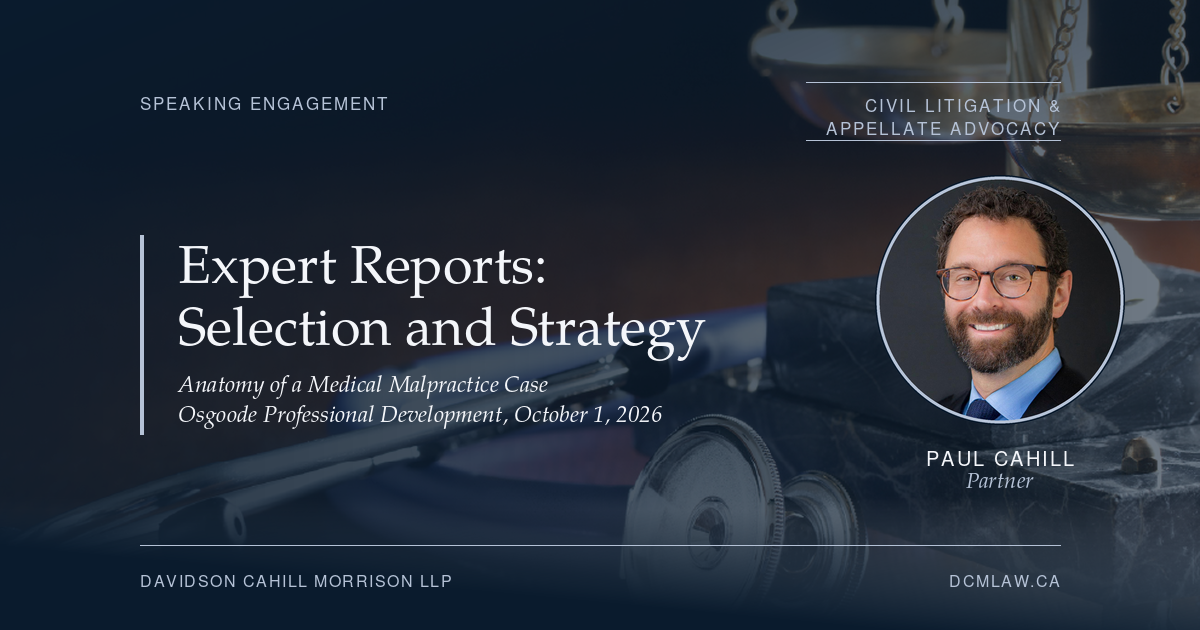
Davidson Cahill Morrison LLP is pleased to announce that partner Paul Cahill will present Expert Reports: Selection and Strategy at Anatomy of a Medical Malpractice Case, a new Osgoode Professional Development program running live online on October 1, 2026. The program is chaired by Richard M. Bogoroch of Bogoroch & Associates LLP and Bronwyn Martin of Moodie Mair Walker Lawyers. Paul’s session is scheduled for 1:30 p.m. ET.
In Medical Negligence, the Expert Evidence Is the Case
Paul’s paper begins from a proposition that separates medical negligence from most other civil litigation. Elsewhere, expert evidence supports the case. Here, it very largely constitutes it.
The standard of care owed by a physician cannot ordinarily be established without expert evidence, and where the subject matter is technical the courts have been explicit that a trier of fact generally cannot condemn a practice the profession itself accepts: ter Neuzen v Korn, [1995] 3 SCR 674. Causation is decided not on scientific certainty but on inference drawn from opinion evidence that is rarely unanimous: Snell v Farrell, [1990] 2 SCR 311. Quantum in a catastrophic injury case is built almost entirely out of assumptions supplied by experts.
The consequence, and the organizing idea of the paper, is that the decisions which determine the outcome of a medical malpractice case are largely made at the expert report stage rather than in the courtroom. Report quality and the durability of an opinion under cross-examination are both constrained by choices made long before trial, and they are difficult to correct later.
Three Jobs, Three Experts
Medical negligence litigation asks experts to do three distinct things: speak to the standard of care, speak to causation, and quantify damages. The paper argues that the temptation to ask one witness to carry more than one of them should generally be resisted.
A plaintiff who economizes by asking a single expert to address both standard of care and causation has created a single point of failure. The defence attacks the weaker limb, and the damage does not reliably stay contained, because an expert discredited on causation is discredited on standard of care.
A related problem is what the paper calls the certainty trap. An expert instructed in terms of medical certainty rather than the balance of probabilities will either overclaim, which can be fatal on cross-examination, or concede uncertainty in language a jury hears as doubt. The causation authorities do not require certainty. Snell permits a robust, common sense inference without positive scientific proof, and the line running through Athey v Leonati, [1996] 3 SCR 458, Clements v Clements, 2012 SCC 32, Ediger v Johnston, 2013 SCC 18, and Sacks v Ross, 2017 ONCA 773, sets out what a plaintiff must actually prove. Asking the expert the medical question instead of the legal one is, in Paul’s assessment, where files are most often lost.
On the standard of care itself, the most recent word from the Supreme Court of Canada is Armstrong v Ward, 2021 SCC 1, which restored a trial finding of breach and cautioned against a results-oriented analysis that reasons backwards from a bad outcome. The expert’s task is to describe the reasonable step, judged as at the time, not to find blame for the result.
Independence Is Now a Threshold Question
The paper’s second part deals with credibility and independence, and with a structural shift that Paul suggests is still under-used in practice. Following White Burgess Langille Inman v Abbott and Haliburton Co, 2015 SCC 23, independence and impartiality are no longer only a matter of weight to be argued in closing. They form part of the properly qualified expert inquiry under R v Mohan, [1994] 2 SCR 9, which means they can be argued at the threshold, on a voir dire, before the jury hears a word.
The test is whether the expert is unable or unwilling to comply with the duty to provide fair, objective and non-partisan opinion evidence. It is a capacity and attitude test rather than a conflicts test, and exclusion remains reserved for very clear cases. A signed Form 53 acknowledgment will generally satisfy the threshold absent challenge, which means the attestation is doing real work. The practical instruction for counsel is to prepare the witness to explain, on the stand, why they are able and willing to comply.
Nor does the gate close once an expert is qualified. In Bruff-Murphy v Gunawardena, 2017 ONCA 502, an expert qualified over the trial judge’s own expressed reservations went on to become an advocate in the witness box. The trial judge treated the qualification ruling as having settled the matter. The Court of Appeal held that the gatekeeping function is ongoing and ordered a new trial. The lesson cuts both ways: a favourable qualification ruling is not a safe harbour, and your own witness’s conduct in the box can cost you the verdict.
What Counsel May and May Not Do With a Draft Report
The third part addresses report drafting and the exchange of work in progress between counsel and expert, an area the paper describes as frequently misremembered. Moore v Getahun, 2015 ONCA 55, leave to appeal refused, is often recalled as having restricted counsel’s involvement with draft reports. It decided close to the opposite. The trial judge had condemned a lengthy discussion between counsel and an expert about a draft and suggested the practice should end. The Court of Appeal reversed, holding that consultation and collaboration between counsel and an expert is not merely permissible but essential.
Paul identifies two opposite failure modes. Some counsel will not discuss a draft with an expert at all, which produces non-compliant reports and unprepared witnesses. Others treat the draft as a joint document, which produces an opinion that is not the expert’s own. Counsel may explain the duty, the issues, the legal test and the evidentiary record, and may review a draft for clarity, completeness and compliance with Rule 53.03. Counsel may not shape the substance of the opinion, script answers, or coach a change in a genuinely held view.
Two pieces of practical hygiene from the paper are worth repeating here. Send the expert the primary records rather than a chronology prepared by counsel, because where the expert works from the summary the assumptions in the report are counsel’s assumptions. And write the instruction letter for the cross-examiner who may one day read it, since it is disclosable under Rule 53.03(2.1)(c).
A Paper Written for Both Sides of the File
One feature of the paper is worth drawing out, because it is unusual in plaintiff-side conference material. Each section closes with a block setting out how the defence will approach that same ground in order to exploit weakness in the plaintiff’s case: bring the voir dire even where it will probably fail, because it produces sworn answers on retainer history and fee arrangements; put the practice-setting gap to the tertiary academic specialist opining on an overnight community emergency department; find the paper the expert authored that cuts against the opinion; ask whether the expert worked from the chart or from counsel’s summary.
The approach reflects how Paul prepares cases. The defence blocks are offered to plaintiff counsel as a pre-service audit of their own expert rather than only as a cross-examination checklist for the other side’s, and they make the paper directly useful to defence counsel as well. That fits a program built for both sides of the file, with a faculty drawn from plaintiff and defence practices as well as LAWPRO.
About the Program
Rather than moving topic by topic, Anatomy of a Medical Malpractice Case is built around a single case drawn from a real-life fact scenario, which the faculty carries from the first client interview through pleadings, production, discovery, expert reports and trial preparation. Other sessions address drafting the claim, audit trails and unauthorized access to medical records, choosing discovery witnesses, pre-discovery requests for production, discovery techniques, stress-testing expert evidence before trial, and the risks and remedies where expert reports are delivered late. A judicial panel closes the day.
- Live online: October 1, 2026, 9:00 a.m. to 4:00 p.m. ET
- Scheduled replay: December 4, 2026, with the ability to submit questions
- Fee: $495 plus tax, with a discount for newly licensed lawyers
- LSO CPD: 6 hours total, comprising 4 hours 45 minutes substantive and 1 hour 15 minutes professionalism
- LAWPRO: approved for the Risk Management Credit
- Access: registration includes 120 days of unlimited online access to the recording
The full agenda, faculty list and registration are available on the Osgoode Professional Development program page.
About Paul Cahill
Paul Cahill is a partner at Davidson Cahill Morrison LLP and a Law Society of Ontario Certified Specialist in Civil Litigation. His practice focuses on plaintiff-side medical malpractice, with particular emphasis on surgical negligence, obstetrical injury and delayed diagnosis claims. He has appeared at all levels of court in Ontario and is recognized by Best Lawyers in Canada for Medical Negligence and Personal Injury Litigation. Paul speaks regularly for the Ontario Trial Lawyers Association, the Law Society of Ontario and other professional bodies, and guest lectures at the University of Windsor Faculty of Law.
About Davidson Cahill Morrison LLP
Davidson Cahill Morrison LLP is a boutique civil litigation and appellate advocacy firm based in Toronto, with offices in Huntsville and Bowmanville. The firm’s practice areas include medical malpractice, personal injury, insurance law, municipal litigation and appellate advocacy.
Contact
For enquiries about Paul’s presentation, or to discuss a potential medical malpractice claim, please contact our office through dcmlaw.ca or visit paulcahill.ca.
Anatomy of a Medical Malpractice Case is presented by Osgoode Professional Development at York University, an accredited CPD provider with the Law Society of Ontario, the Law Society of British Columbia and the New York CLE Board.