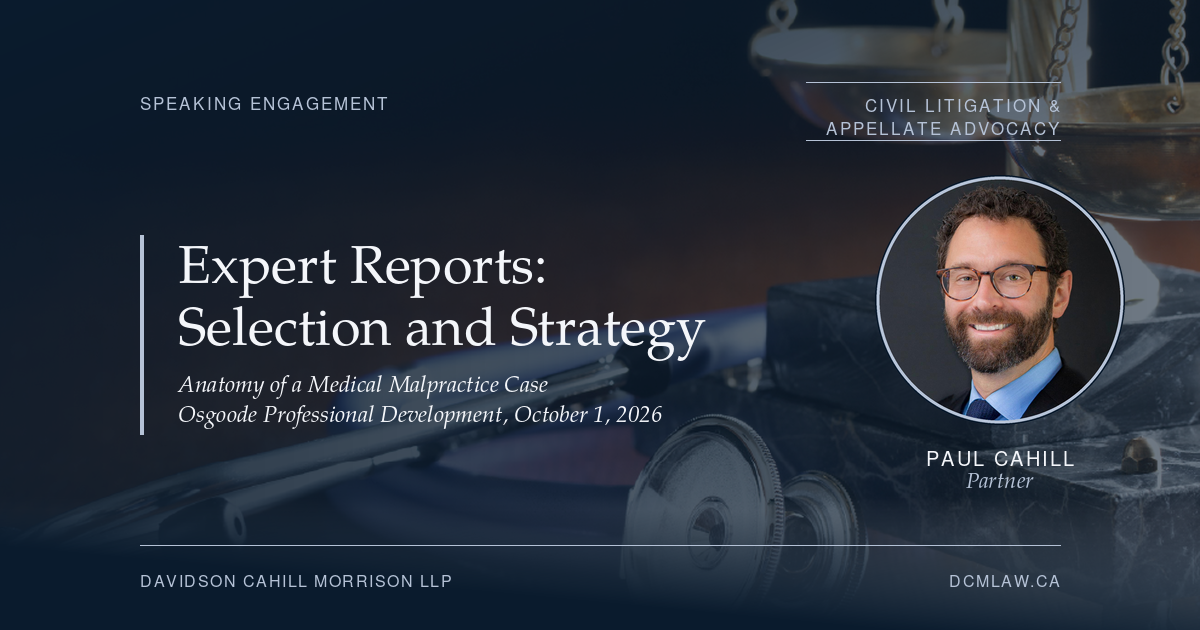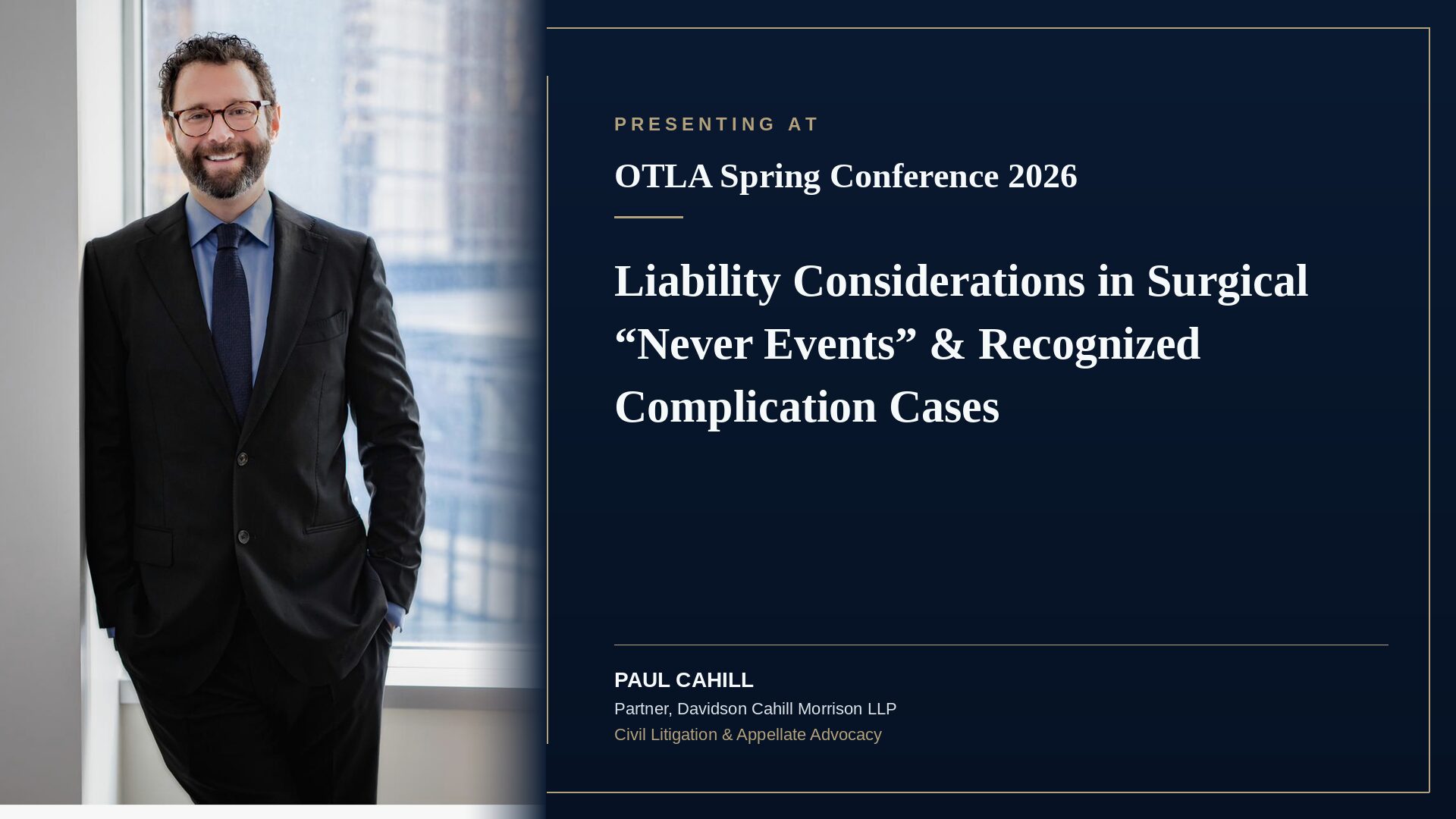
Davidson Cahill Morrison LLP is pleased to announce that partner Paul Cahill will be presenting at the Ontario Trial Lawyers Association (OTLA) Spring Conference 2026. His paper, Liability Considerations in Surgical “Never Events” or Recognized Complication Cases, addresses one of the most difficult areas of plaintiff-side medical malpractice practice: proving negligence when the alleged misconduct occurred behind the closed doors of an operating room.
A Uniquely Difficult Area of Medical Malpractice Law
Surgical negligence litigation is unlike most other forms of medical malpractice. The patient is under general anesthesia. There are rarely independent witnesses. Operative notes, often dictated hours after the procedure, tend to summarize how a surgery should have proceeded rather than how it actually unfolded.
Within intraoperative claims, two categories tend to dominate plaintiff practice. The first are so-called “never events,” injuries that on their face appear inconsistent with competent surgical practice. The second, and far more challenging, are “recognized complications,” adverse outcomes characterized by the defence as accepted risks of an otherwise properly performed procedure.
In Paul’s experience, the line between these two categories is often blurred. Many cases that initially present as recognized complications can, on closer analysis, be reframed as never events once the mechanism of injury is properly understood.
The Central Legal Tension
Canadian negligence law is clear that liability cannot be inferred from outcome alone. A poor result, no matter how devastating, does not by itself prove that the standard of care was breached. Yet in surgical cases, outcome is frequently the most compelling piece of evidence available.
The task for plaintiff’s counsel, as Paul’s presentation sets out, is to bridge that gap by transforming outcome into inference, and inference into proof of substandard care.
Key Themes Paul Will Address
Paul’s presentation draws on the governing framework established by the Supreme Court of Canada in Armstrong v. Ward, 2021 SCC 1, and on two of his own reported cases:
- O’Neill-Renouf v. Ibrahim, 2019 ONSC 4369, where the Court accepted that an obturator nerve injury sustained during a transvaginal tape procedure was best explained by direct surgical trauma rather than the defence theory of edema. The case demonstrates how circumstantial evidence, particularly immediate symptom onset and anatomical specificity, can establish surgical negligence even where the operative report suggests an unremarkable procedure.
- Knight v. Lawson, 2023 ONSC 570, where a ureteric injury claim ultimately failed at trial. The case illustrates the limits of inferential reasoning where the defence is able to establish that certain types of injury, including thermal and ischemic mechanisms, may not be visible at the time they occur.
Paul’s analysis also addresses three recurring evidentiary challenges in this area of practice:
- Expert reluctance, and how to identify experts who will engage with mechanism and probability rather than retreat into the language of recognized complications.
- Incomplete medical records, including how perioperative nursing notes, anesthesia records, post-operative observations, and the timing of symptoms can be assembled to reconstruct what most likely occurred.
- The absence of direct evidence, and the disciplined approach required to ensure that inferential reasoning remains grounded in the evidentiary record rather than speculation.
A Practical Framework for Plaintiff Counsel
The presentation’s central thesis is that the most successful intraoperative surgical negligence cases share three features. The mechanism of injury is clearly identified. The defence explanations are systematically dismantled. And the inference of negligence emerges not as speculation, but as the most reasonable conclusion available on the evidence.
Paul’s goal is to provide plaintiff counsel with a practical framework for moving the Court away from treating the operative note as a definitive account of what occurred, and toward a more realistic understanding of the surgical record as one piece of evidence: important, but neither exhaustive nor immune from scrutiny.
About Paul Cahill
Paul Cahill is a partner at Davidson Cahill Morrison LLP and an experienced medical malpractice lawyer in Ontario. His practice focuses on complex civil litigation, with a particular emphasis on surgical negligence, obstetrical injury, and other plaintiff-side medical malpractice claims. He has appeared at all levels of court in Ontario and is regularly invited to speak on issues of liability, expert evidence, and trial strategy in medical negligence litigation.
About Davidson Cahill Morrison LLP
Davidson Cahill Morrison LLP is a boutique civil litigation and appellate advocacy firm based in Toronto with offices in Huntsville and Bowmanville. The firm’s practice areas include medical malpractice, personal injury, insurance law, municipal litigation, and appellate advocacy.
Contact
For media enquiries about Paul’s OTLA presentation, or to discuss a potential surgical negligence claim, please contact our office at dcmlaw.ca or visit paulcahill.ca.
The OTLA Spring Conference 2026 is hosted by the Ontario Trial Lawyers Association, the leading professional organization representing Ontario plaintiff lawyers and their clients.