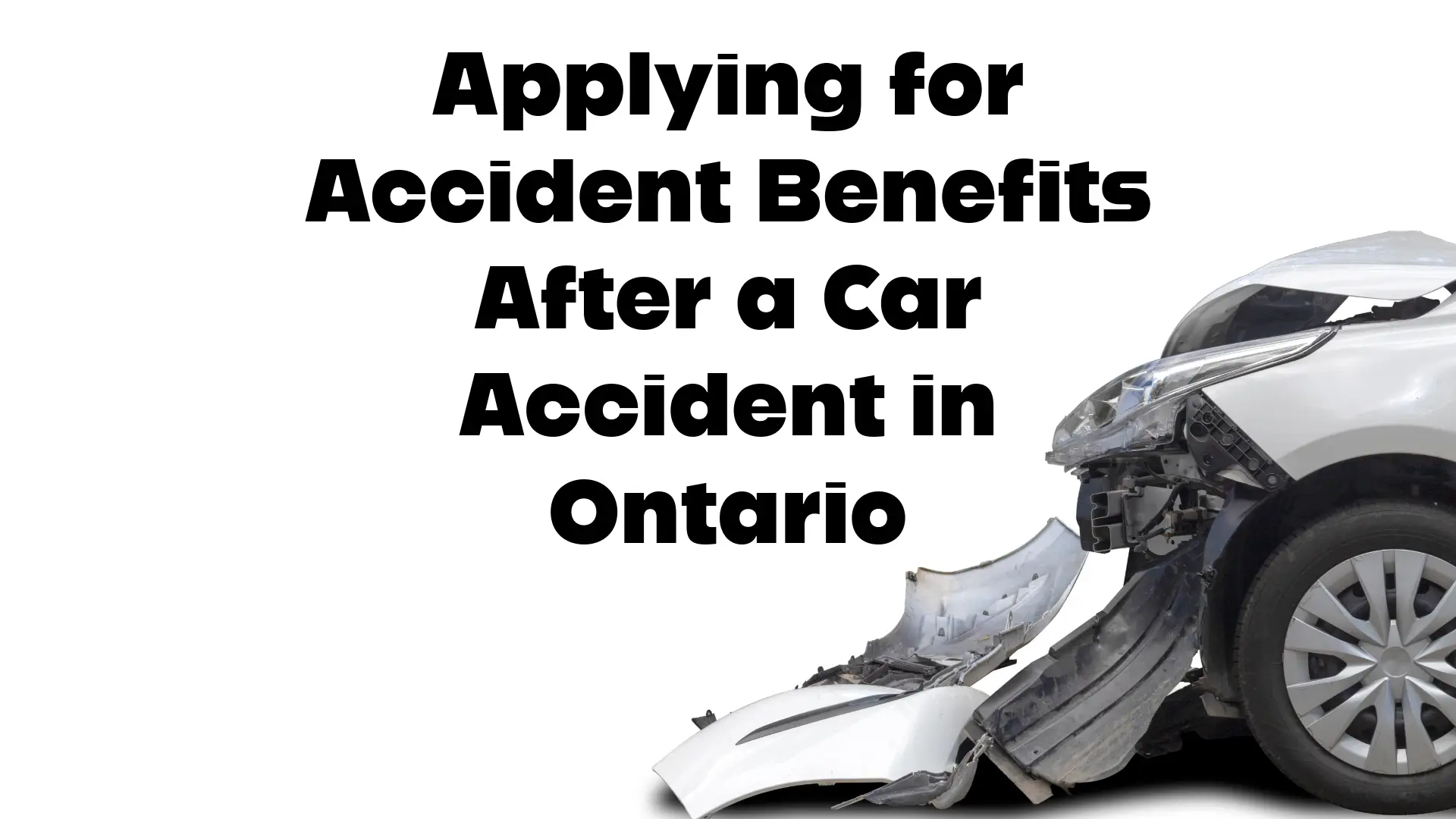
A car accident leaves more than injuries. It brings a wave of paperwork, deadlines, and decisions at the worst possible time. If you have been hurt in a collision in Ontario, accident benefits are usually your first source of support, and applying for them correctly and on time can shape your entire recovery. This guide explains what accident benefits are, what they cover, the changes that took effect in 2026, how to apply, and the deadlines you cannot afford to miss.
What Are Accident Benefits?
Accident benefits are part of Ontario’s no-fault auto insurance system. “No-fault” does not mean no one is responsible. It means you claim these benefits from your own insurer regardless of who caused the crash, so support can begin while fault is still being sorted out. They are set by a regulation called the Statutory Accident Benefits Schedule, or SABS, which applies under every Ontario auto policy.
Accident benefits provide first-party support for things like medical treatment, rehabilitation, attendant care, and, for those who carry the coverage, lost income. They are separate from any lawsuit against the at-fault driver, a distinction we come back to below.
What Changed on July 1, 2026
Ontario made its most significant change to accident benefits in years, and it affects what is automatically included in your policy. Under Ontario Regulation 383/24, effective July 1, 2026:
- Medical, rehabilitation, and attendant care benefits remain mandatory in every auto policy, along with coverage for the cost of examinations.
- Most other benefits are now optional, including income replacement, non-earner, caregiver, housekeeping, death and funeral, lost educational expenses, and coverage for damaged personal items. You can still buy them, but they are no longer automatic.
- Your auto insurer pays first for accident-related medical and rehabilitation costs, except medication, ahead of any workplace or private health plan.
- Who is covered for the optional benefits has narrowed. For accidents on or after July 1, 2026, the optional benefits reach the named insured, their spouse, dependants, and listed drivers. Passengers, pedestrians, and cyclists who fall outside those categories may no longer qualify for the optional benefits, although mandatory medical, rehabilitation, and attendant care remain available to anyone injured.
Two practical points. If your policy renews after July 1, 2026, your existing coverage carries forward unchanged unless you agree in writing to remove or adjust it, so review your declarations before dropping anything. And the rules that govern a claim follow the date of the accident: a crash before July 1, 2026 is dealt with under the old framework even if the claim continues afterward.
What Accident Benefits Cover
Benefit amounts are set by regulation and can change over time, so treat the figures below as the current standard limits and confirm the limits on your own policy.
Medical and Rehabilitation Benefits
These cover treatment that OHIP does not, such as physiotherapy, chiropractic care, psychological treatment, and assistive devices. The amount available depends on how your injuries are classified:
- Minor injuries (sprains, strains, whiplash) are capped at $3,500 under the Minor Injury Guideline.
- Non-catastrophic injuries (for example, fractures) carry a combined medical, rehabilitation, and attendant care limit of $65,000, available for up to five years.
- Catastrophic impairments (such as serious brain injury, paralysis, or loss of a limb) carry a combined limit of $1,000,000 over your lifetime.
How an injury is classified has an enormous effect on the funding available, and insurers do not always get it right. A classification can be challenged, and an injury can move from one category to another as its severity becomes clear.
Attendant Care
Attendant care helps pay for a personal support worker, attendant, or care facility to assist with daily activities like bathing, dressing, and eating. It is not available for minor injuries, and it shares the $65,000 non-catastrophic or $1,000,000 catastrophic limit above.
Income Replacement Benefits
If your injuries keep you from working, income replacement benefits pay 70% of your gross weekly income, up to a standard maximum of $400 per week. Optional coverage can raise that ceiling to as much as $1,000 per week. Because $400 a week rarely covers a household’s expenses, the gap between your actual income loss and the benefit is often pursued separately, in a claim against the at-fault driver.
Non-Earner Benefits
If you were not employed at the time of the accident, for example a student or a retiree, and you suffer a complete inability to carry on a normal life, you may qualify for a non-earner benefit of $185 per week, beginning after a four-week waiting period.
Other Benefits
Depending on your coverage and circumstances, the SABS may also provide caregiver benefits, housekeeping and home maintenance, lost educational expenses (up to $15,000), visitor expenses, and replacement of damaged personal items. If someone dies in an accident, a death benefit can pay $25,000 to a spouse, $10,000 to each dependant, and up to $6,000 toward funeral expenses. After July 1, 2026, these are optional coverages.
How to Apply, Step by Step
- Notify your insurer right away. Report the accident to your own auto insurer as soon as possible, and they will send you the application package. If your injuries prevent you from calling, have someone do it for you.
- Complete the application (OCF-1). The Application for Accident Benefits (OCF-1) is the gateway to the system. Fill it out carefully and accurately.
- Gather the supporting forms. A health practitioner completes the Disability Certificate (OCF-3), and your treatment provider submits a Treatment and Assessment Plan (OCF-18). If you are claiming income replacement, your employer completes the Employer’s Confirmation of Income (OCF-2), and a separate election form (OCF-10) is used to choose between income replacement, non-earner, and caregiver benefits.
- Keep everything. Hold on to receipts, mileage, medical records, and a log of every call and letter with your insurer. Good records win disputes.
Deadlines You Cannot Miss
The system runs on strict deadlines, and missing one can cost you your benefits:
- 7 days to notify your insurer of the accident, or as soon as practicable.
- 30 days to return the completed OCF-1 after you receive the application package.
- 2 years to dispute a denied or terminated benefit at the Licence Appeal Tribunal (LAT), measured from the insurer’s refusal.
Common Mistakes to Avoid
- Downplaying your injuries. Concussion, chronic pain, and psychological injury can emerge or worsen over time. Describe the full picture, honestly and completely.
- Missing a deadline. Calendar the 7-day, 30-day, and 2-year limits and treat them as hard.
- Submitting incomplete forms. Gaps and inconsistencies invite denials and delay. Double-check before you submit.
- Facing a denial alone. Insurers deny and terminate benefits routinely, and you do not have to accept a denial at face value.
If Your Claim Is Denied
A denial is not the end of the road. You are entitled to written reasons, and you can dispute the decision at the Licence Appeal Tribunal within two years. Many denials turn on a treatment plan, a benefit classification, or an insurer’s medical assessment, each of which can be challenged with the right evidence. This is often the point at which legal advice makes the biggest difference.
Accident Benefits Are Not the Same as Suing the At-Fault Driver
Accident benefits are first-party, no-fault, and capped. A tort claim against the at-fault driver is different: it can compensate for pain and suffering and for the income loss that exceeds the accident-benefit cap. The two work together, but they are not duplicates. Benefits you have already received are generally taken into account when a tort claim settles, to prevent double recovery. If your injuries are serious, you may have both a benefits claim and a lawsuit underway at the same time, and it helps to understand how long a personal injury claim takes.
How a Personal Injury Lawyer Can Help
The accident-benefits process is detailed, deadline-driven, and built around an insurer that does this every day. Our personal injury lawyers can make sure your application is complete and on time, push back on an unfair classification or denial, coordinate your benefits with any tort claim, and represent you at the Licence Appeal Tribunal if it comes to that. The earlier we are involved, the more we can protect.
Frequently Asked Questions
Do I still get accident benefits if the accident was my fault? Yes. Accident benefits are no-fault, so you can claim them regardless of who caused the collision.
How long do I have to apply? Notify your insurer within seven days, and submit the completed OCF-1 within 30 days of receiving it. If a benefit is later denied, you have two years to dispute it at the Licence Appeal Tribunal.
I was a passenger, pedestrian, or cyclist. Am I covered? You can still access mandatory medical, rehabilitation, and attendant care benefits. For accidents on or after July 1, 2026, however, the now-optional benefits such as income replacement may not be available to you unless you fall within the covered group on a responding policy. Speak to a lawyer about which policy responds in your situation.
Will claiming affect my premium? Accident benefits are first-party, no-fault benefits. Whether a claim affects your premium can depend on the circumstances, so confirm with your insurer or broker.
Talk to Us
If you have been injured in a car accident in Ontario, you do not have to navigate the accident-benefits system alone. Contact us for a free consultation, and let our team help you secure the support you need to recover.