
Proven Courtroom Advocates · Offices in Toronto, Huntsville and Bowmanville

Medical Malpractice · Ontario

Medical Malpractice Lawyers in Toronto

Harmed by medical care in Ontario? Our medical malpractice group is led by Paul Cahill, a Certified Specialist in Civil Litigation who has tried and won serious medical negligence cases. Tell us what happened, and we will tell you where you stand.

Free consultation · We respond within one business day · Acting for patients and families across Ontario

  • Certified Specialists in Civil Litigation
  • Best Lawyers in Canada, Medical Negligence
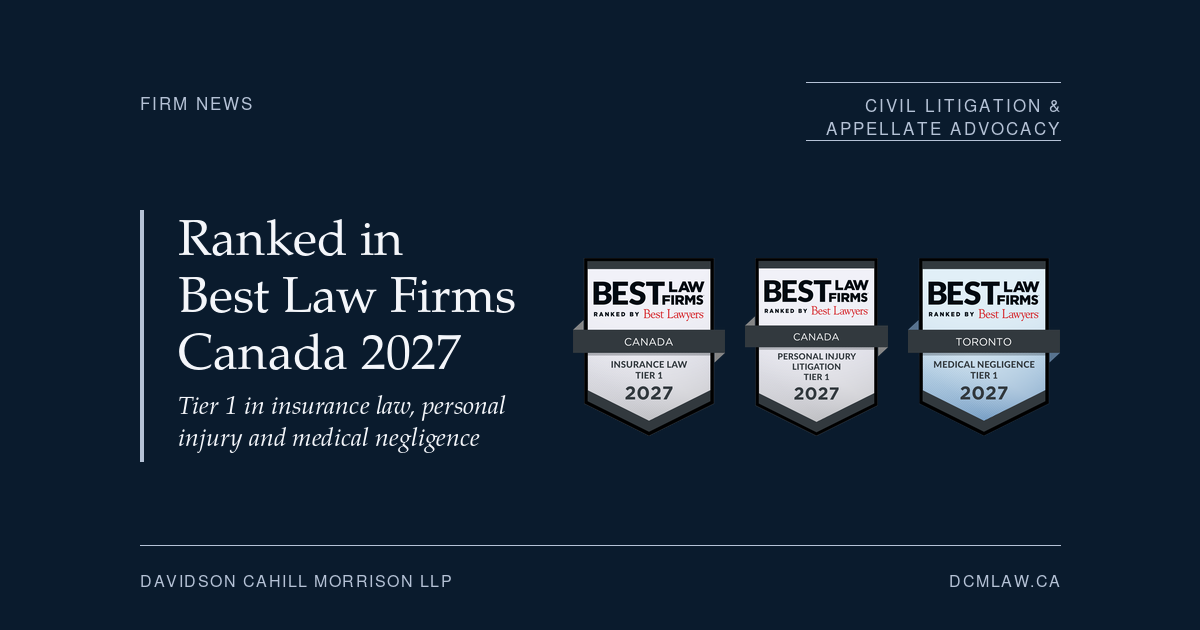
  • Tier 1, Best Law Firms in Canada 2027
  • Contingency fees available

Injured by medical care?

When medical care causes serious harm

A birth injury that leaves a child with lifelong needs. A cancer that goes undiagnosed until it is too late. A routine surgery that ends in catastrophe. When medical care goes wrong, families are left with questions, mounting costs and few answers.

Partner Paul Cahill leads the medical malpractice group at Davidson Cahill Morrison LLP, working with associate Hudson Chalmers. Paul's trial results include an $11.5 million judgment for a child with cerebral palsy caused by obstetrical negligence, and a judgment against an emergency room physician for the death of a 34-year-old mother of four.

A bad outcome is not always malpractice. Medicine carries risk, and the legal question is whether the care fell below the standard the profession expects and caused the harm. That is what we assess, at no cost to you. For a fuller explanation, see how medical malpractice claims work in Ontario.

The partners of Davidson Cahill Morrison LLP

Where we act

The medical malpractice cases we take on

We act for patients and families in serious medical negligence claims across Ontario. If your situation is not listed, ask us.

Birth injury and cerebral palsy

Obstetrical and neonatal negligence causing hypoxic ischemic encephalopathy (HIE) and cerebral palsy, including delayed delivery and midwifery care.

Surgical errors

Negligence in general, gynaecological, urological, orthopaedic, vascular, neurological and other surgery.

Misdiagnosis and delayed diagnosis

Cancer and other serious conditions that are missed or left to progress, including abnormal test results that are not followed up.

Emergency room delay

Missed or delayed diagnosis in the emergency department, where minutes matter. Read When Seconds Count.

Stroke and neurological misdiagnosis

Strokes and neurological emergencies that are not recognized or treated in time.

Post-operative care

A failure to monitor or respond to complications after surgery, such as bleeding, infection or sepsis.

Medication errors

Prescribing, dispensing and administration errors, dangerous drug interactions and dosing mistakes.

Lack of informed consent

Treatment that goes ahead without proper disclosure of the material risks a reasonable patient would want to know.

Hospital and nursing home neglect

Falls, pressure injuries and other harm caused by inadequate care in hospitals and long-term care homes.

The legal test

What a medical malpractice claim must prove

To succeed, an injured patient must prove four things. The burden rests on the patient throughout, and most of these points are contested.

1

A duty of care

A health care provider owes a patient a duty to take reasonable care. This is rarely in dispute once treatment begins.

2

A breach of the standard

The care fell below what a reasonably competent provider in the same field would have done in the circumstances.

3

Causation

The breach caused the injury. This is often the hardest element to prove, and the one most heavily fought.

4

Damages

Real harm and real loss: injury, the cost of care, lost income and the human toll that follows.

The standard of care and causation are proved through independent medical experts in the relevant specialty. Physicians are usually defended by the Canadian Medical Protective Association, and hospitals by their own insurers, so the quality of the experts on your side often decides the case.

Why acting quickly matters

How long you have to bring a claim

Ontario's Limitations Act, 2002 sets strict deadlines for medical malpractice claims. Missing one can end a claim before it begins.

2 years

The basic deadline

You generally have two years to start a claim. The clock starts when you knew, or ought reasonably to have known, that you were harmed by someone's care, which can be later than the date of treatment.

Under 18

Children

For a child, the two-year clock does not run while they are under 18 and not represented by a litigation guardian. This matters in birth injury cases.

15 years

The outer limit

A separate ultimate limitation period bars most claims 15 years after the act or omission, whenever the harm was discovered. Exceptions apply to children and people who are incapable.

Building a medical case takes time, because the records must be gathered and experts retained. Speak with a lawyer as soon as you suspect something went wrong, even if you think a lot of time has passed.

A proven track record

Results in medical malpractice claims

Our lawyers have recovered millions for patients and families harmed by medical negligence, at trial and through settlement.

$11.5 Million

Trial judgment against an obstetrician whose negligence caused cerebral palsy in a twin girl, upheld by the Court of Appeal for Ontario (2020).

$4.5 Million

Recovered for a patient who suffered a serious disability after a phlebotomy procedure (2023).

$2.3 Million

Trial judgment against an emergency room physician for the death of a 34-year-old mother of four young children (2023).

$700,000

Settlement for the family of a mother of two who died after a delayed breast cancer diagnosis; liability was highly contested (2023).

$400,000

Recovered for the family of an older patient who died of sepsis after abdominal surgery (2023).

Past results are not necessarily indicative of future results. Amounts recovered and other litigation outcomes will vary according to the facts of each individual case.

Why clients trust us

Recognized by the profession

Certified Specialists

David Morin, Jim Davidson and Paul Cahill are certified by the Law Society of Ontario as Specialists in Civil Litigation, a designation granted to lawyers who meet established standards of experience and knowledge.

Best Lawyers in Canada

Paul Cahill has been recognized in The Best Lawyers in Canada for Medical Negligence and Personal Injury Litigation since 2021, including the 2027 edition.

Tier 1 firm

Ranked Tier 1 for Medical Negligence in Toronto in Best Law Firms in Canada 2027.

Hear from former clients in their own words on our testimonials page.

The people

Who will handle your case

You deal with the lawyers doing the work, not a rotating cast.

Partner · Group Lead

Paul Cahill

Certified Specialist in Civil Litigation and a past director of the Ontario Trial Lawyers Association. Paul has tried and won serious medical negligence cases, and other lawyers retain him as trial counsel.

Read Paul's profile

Associate

Hudson Chalmers

Hudson's practice covers personal injury and insurance litigation, with a particular interest in medical malpractice. He has judged medical malpractice moot and mock trial competitions.

Read Hudson's profile

Free consultation

Talk to a medical malpractice lawyer

Tell us what happened, with as much detail as you can. We respond within one business day. There is no cost and no obligation.

☎ 1 (800) 661-7606
Name
Would you like to join our mailing list for legal updates and news in our practice areas of insurance law, medical malpractice, appellate advocacy, personal injury and municipal litigation?

Fees and access

Contingency fee representation

Everyone should have access to quality legal representation, regardless of their financial situation. For medical malpractice claims, we offer competitive, sliding-scale contingency fee representation.

Because these cases are costly and complex, only select matters can be offered a contingency fee agreement from the start. In some cases, we ask for an investigation retainer first. It is held in trust and applied to the cost of completing the medical records and obtaining a preliminary opinion from an independent medical specialist. If that opinion supports a claim, we offer contingency fee representation from that point forward.

  • You pay us nothing unless we win or settle your case
  • The earlier your case resolves, the less you pay in legal fees
  • If we do not succeed, you owe us nothing, not even disbursements
  • Your first consultation carries no obligation

Common questions

Medical malpractice claims in Ontario: FAQ

How do I know if I have a medical malpractice case?

A bad outcome is not the same as malpractice. A claim requires care that fell below the accepted standard, and proof that the substandard care caused the injury. We review your account and the medical records, and where a claim looks possible, we obtain an independent expert opinion before advising you. You can also read Can I sue for medical malpractice?

How long do I have to sue for medical malpractice in Ontario?

You generally have two years from when you knew, or ought reasonably to have known, that you were harmed by someone's care. Different rules apply to children and people who are incapable, and an ultimate limitation period bars most claims 15 years after the act or omission. Because these rules depend on the facts, get advice as soon as you suspect something went wrong.

What does it cost to hire a medical malpractice lawyer?

Your first consultation is free. We offer sliding-scale contingency fee representation for select medical malpractice claims, which means you pay no legal fees unless we win or settle your case. In some cases, we ask for an investigation retainer to obtain the medical records and a preliminary expert opinion before offering a contingency fee agreement.

Is a complaint to the CPSO the same as a lawsuit?

No. The College of Physicians and Surgeons of Ontario (CPSO) can investigate a doctor's conduct and impose discipline, but it does not award compensation. A civil lawsuit is the route to financial recovery. The two processes are separate and can proceed at the same time. For more information, see How to make a complaint to the CPSO.

How long does a medical malpractice case take?

Medical malpractice cases usually take several years, because they depend on complete records, expert opinions, examinations for discovery and, often, mediation. Most claims resolve before trial. We explain what to expect for your case at the outset.

Do you take cases outside Toronto?

Yes. We act for patients and families across Ontario, with offices in Toronto, Huntsville and Bowmanville.

From the blog

Recent insights on medical malpractice

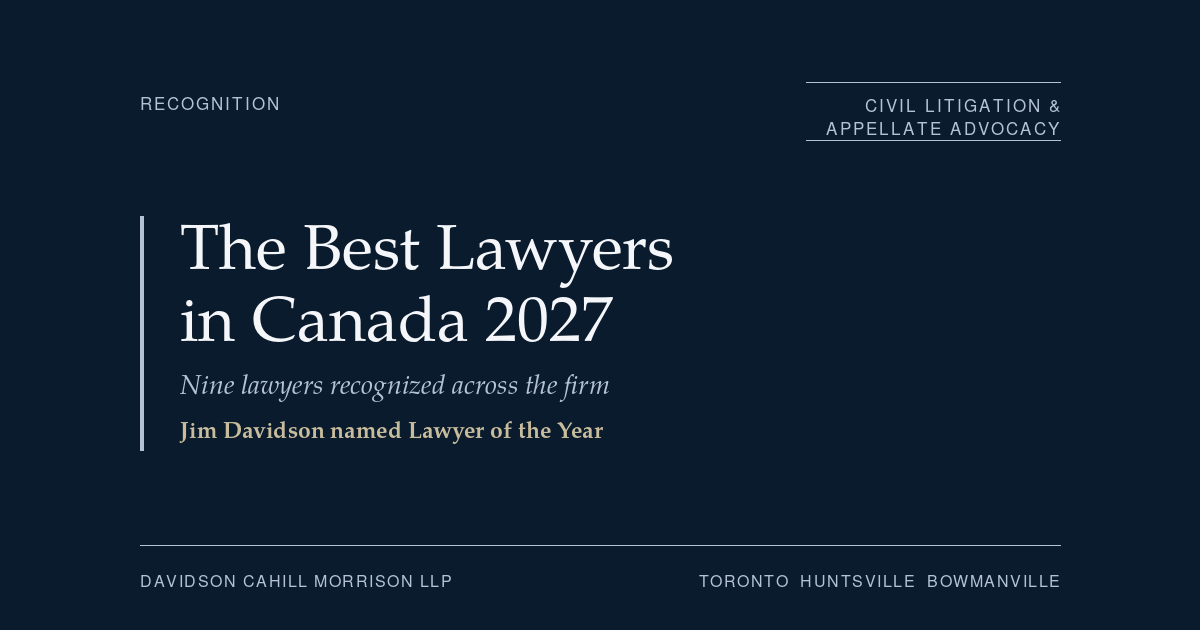
Nine Davidson Cahill Morrison LLP lawyers recognized in The Best Lawyers in Canada 2027, including Lawyer of the Year Jim Davidson.

Davidson Cahill Morrison LLP Lawyers Recognized in The Best Lawyers in Canada 2027 Edition

Jim Davidson has been named a 2027 Lawyer of the Year for Personal Injury Litigation in Toronto, and nine Davidson Cahill Morrison LLP lawyers are recognized in The Best Lawyers in Canada and Best Lawyers: Ones to Watch in Canada. The recognitions span insurance law, medical negligence, and personal injury litigation, and are decided entirely by peer review.

Read More »