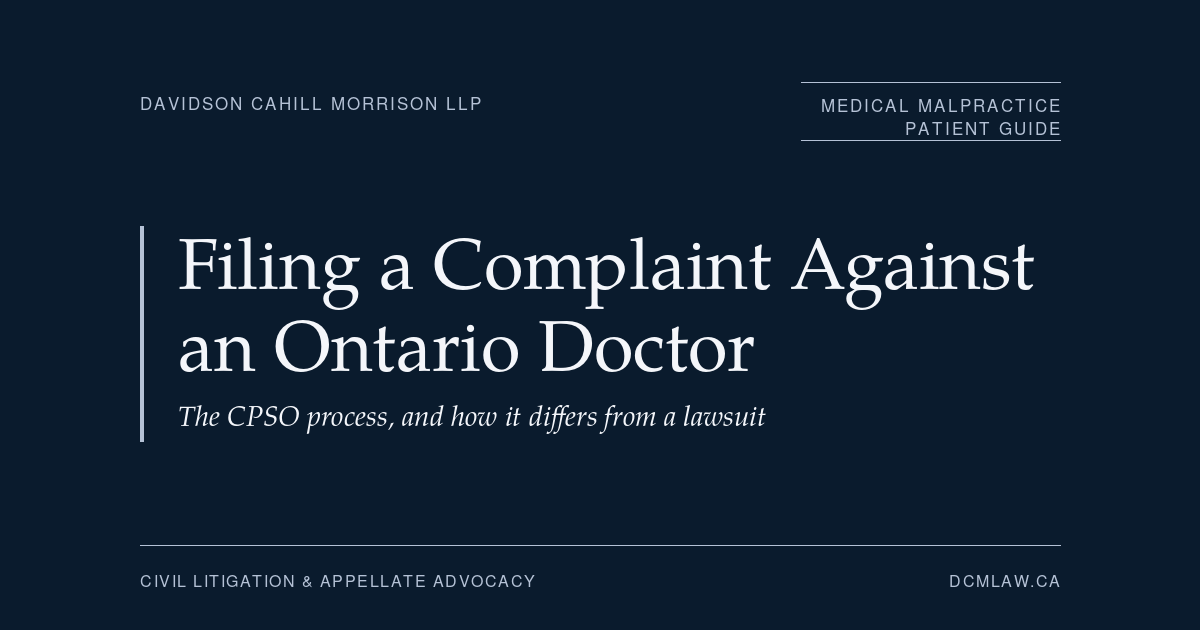
If you believe an Ontario doctor provided substandard care or behaved improperly, you have two separate paths, and they do different things. A complaint to the College of Physicians and Surgeons of Ontario (CPSO) is about the doctor’s conduct and competence, and it is how the profession is held to account. A medical malpractice claim is about compensation for the harm you suffered. This guide explains how the CPSO complaint process actually works, what it can and cannot do for you, and how it differs from a lawsuit, so you can decide which path, or both, makes sense.
What the CPSO Is, and What It Can and Cannot Do
The CPSO is the regulator for physicians in Ontario. It operates under the Regulated Health Professions Act, 1991 and the Health Professions Procedural Code, and its job is to protect the public by setting standards, registering doctors, investigating concerns, and disciplining physicians who fall short.
It is important to be clear about the limits of that role. The CPSO is not a patient advocate and it is not a legal service. It cannot award you money, it cannot order a doctor to compensate you for your losses, and it cannot force a doctor to apologize. A complaint can lead to consequences for the physician and can flag a problem for the public, but it will not put money in your pocket. That is what a civil claim is for, and we come back to the difference below.
What You Can Complain About
A complaint can raise any genuine concern about a physician’s care or conduct, including:
- The quality or competence of medical care, including a missed or delayed diagnosis or a surgical or treatment error
- Communication, professionalism, or rudeness
- Boundary, ethical, or consent issues
- Poor or inaccurate medical records
- Confidentiality breaches
- Billing or other professional-conduct concerns
You do not need to prove your case before you complain. Describing your concern clearly, and backing it up with records and dates, is enough to start the process.
Before You File
The College suggests trying to resolve the issue directly first, where that is appropriate. Depending on where you were treated, you can also raise concerns with the hospital’s patient experience or patient relations office, the administration of the Family Health Team where the doctor practises, or the Ontario Patient Ombudsman.
There is no formal deadline to file a complaint. That said, physicians are only required to keep adult patient records for ten years, and the more time that passes, the harder an investigation becomes, so it is best to complain as soon as you can. Be aware that complaining is not the same as suing, and a complaint does not pause the limitation period for a civil claim (more on that below).
The College generally cannot act on an anonymous complaint, because the physician is entitled to see the complaint and respond to it. If a complaint is made by someone other than the patient, the College will usually need the patient’s consent to access the medical records.
How to File a Complaint, Step by Step
- Gather your information and documents. Collect your details and the patient’s (if different), the physician’s name and practice information, the dates and a description of what happened, copies of relevant medical records and correspondence, and anything else that supports your concern.
- Complete the complaint form. You can file a complaint through the Complaints and Concerns section of the College’s website at cpso.on.ca. A complaint must be in writing (the online form satisfies this). If you experienced sexual abuse by a physician, the College has a dedicated support line and a social worker who can help you through the process.
- Be clear and specific. Set out what happened, when, and why it concerns you. Attach your supporting documents so the College has the full picture from the start.
What Happens After You File
Once your complaint is received, the College sends the physician a copy and asks for a written response, which the physician has a professional duty to provide. The College’s Investigations and Resolutions Department investigates: it gathers records, may interview you and the physician, gives you a copy of the physician’s response, and lets you reply.
The investigator’s report then goes to the Inquiries, Complaints and Reports Committee (ICRC), a committee made up of both physicians and public members. The ICRC reviews the file on the documents, it does not hold a live hearing, and both you and the physician receive its decision and, in most cases, written reasons.
The Code sets a target of 150 days for the committee to dispose of a complaint, but that timeline is a guideline rather than a hard rule, and a complex investigation can take a year or more. In serious cases where there is a risk to patients, the College can impose interim restrictions on a physician’s practice while the investigation continues.
Possible Outcomes of a Complaint
After reviewing the file, the ICRC can:
- Take no further action
- Advise the physician on how to improve, or require remedial self-study
- Accept an undertaking, a signed commitment by the physician to improve or restrict their practice
- Require the physician to complete specific education or remediation (a Specified Continuing Education or Remediation Program, or SCERP)
- Issue a caution, delivered in person before the committee
- Refer the matter to the Ontario Physicians and Surgeons Discipline Tribunal, the most serious step
Some of these outcomes are public. Specified continuing education and remediation programs, oral cautions, and referrals to discipline are posted on the physician’s profile on the College’s public register. If a matter is referred to discipline, the Tribunal holds a hearing and, if it finds professional misconduct or incompetence, can impose penalties up to and including suspension or revocation of the physician’s certificate of registration. Discipline decisions can be appealed to the Divisional Court.
If You Disagree With the Outcome: HPARB Review
If you are not satisfied with the ICRC’s decision, you can ask the Health Professions Appeal and Review Board (HPARB) to review it. A request must be made in writing within 30 days of receiving the decision. (There is no HPARB review where the matter was referred to discipline or to a fitness-to-practise process; those follow their own track.)
An HPARB review is narrow. It looks at two things only: whether the College’s investigation was adequate, and whether the ICRC’s decision was reasonable. HPARB does not re-examine the quality of your medical care and it cannot award you money. It can confirm the decision, send it back to the ICRC, or require the committee to take certain steps. HPARB decisions can in turn be challenged by judicial review at the Divisional Court.
A CPSO Complaint Is Not a Medical Malpractice Lawsuit
This is the distinction that matters most, and it is the one patients most often get wrong.
A CPSO complaint is regulatory. It addresses the physician’s conduct to protect the public. It does not compensate you, and the complaint file and the ICRC’s decision are generally not admissible in a civil lawsuit, because the legislation protects College proceedings from being used in court. A regulatory outcome, even a caution or a discipline finding, is not the same as a court finding that the doctor is legally liable to you.
A medical malpractice claim is a civil action for compensation. To succeed, you must prove two things: that the care fell below the standard of a reasonable physician in the circumstances, and that the substandard care caused you harm. Both usually turn on expert medical evidence, and the standard of care is a question for those experts, not something a complaint decision settles. Because this kind of litigation is expensive to run, and because physicians are defended vigorously, a claim generally only makes sense where the harm is significant.
Two further points are worth keeping front of mind:
- The two paths are separate, and you can pursue both. A complaint can deliver accountability and help protect other patients; a claim can deliver compensation. One is not a substitute for the other.
- A complaint does not protect your right to sue. Filing with the CPSO does not stop the clock on a civil claim. In Ontario, you generally have two years from when you knew, or ought to have known, that you had a claim to start a lawsuit, under the Limitations Act, 2002. If compensation may matter to you, speak to a lawyer early so a limitation period does not quietly expire while a complaint is working its way through the College.
Should You Complain, Sue, or Both?
If your goal is to hold a doctor accountable or to flag conduct that could affect other patients, a complaint is the right tool, and you should make one where you feel it is warranted. If you have suffered serious harm and want compensation, that is a question for a civil claim, and the two can run at the same time. The safest course, if you are unsure, is to talk to a medical malpractice lawyer before you decide, so you understand your options and protect your limitation period.
Frequently Asked Questions
Will the CPSO get me compensation? No. The CPSO regulates physicians and can discipline them, but it cannot award money or order a doctor to pay your losses. Compensation comes from a civil claim.
Is there a deadline to file a complaint? There is no formal deadline, but sooner is better because records and memories fade. Note that a complaint does not extend the two-year limitation period for a lawsuit.
Can I file a complaint and sue at the same time? Yes. A regulatory complaint and a civil claim are separate processes with different purposes, and pursuing one does not prevent the other.
What if I disagree with the College’s decision? You can ask HPARB to review the decision within 30 days. HPARB looks at whether the investigation was adequate and whether the decision was reasonable; it cannot reassess your care or award money.
Will my complaint be made public? Most outcomes are not published, but specified education or remediation programs, oral cautions, and referrals to discipline are posted on the physician’s public register profile.
Talk to a Medical Malpractice Lawyer
Making a complaint is an important way to raise concerns about your care. If you are also wondering whether you have a claim worth pursuing, that is a separate question, and an early conversation can make all the difference. Our medical malpractice lawyers, led by Paul Cahill, can help you understand whether you may have a case and how to protect your rights. Contact us for a confidential consultation.