Proven Courtroom Advocates · Offices in Toronto, Huntsville and Bowmanville

Category

Medical Malpractice

Civil Litigation & Appellate Advocacy

Medical malpractice, or medical negligence, concerns harm caused when care falls below the standard a reasonable practitioner would have met. Establishing a claim requires expert evidence on both the standard of care and causation, and the issues are often technical and specialty specific.

Posts in this category analyze Ontario decisions on standard of care, causation, consent and damages, along with the regulatory and discipline jurisprudence that runs parallel to civil litigation. The aim is to explain what those decisions mean for injured patients and their families, and for the lawyers who represent them.

This commentary is background only. The standard of care in any given case is a question for expert evidence, not for a website.

Interior of Osgoode Hall

Shaw Estate v. Handler – Court of Appeal Dismisses ER Doctor’s Appeal of Judgment Against Him Relating to Death of 34-Year Old Mother of 4

Elisha Shaw was 34 and a mother of four when she died after being discharged from an emergency department with an undiagnosed internal hernia. After a 12-day trial, the Ontario Superior Court found the emergency physician negligent. In Shaw Estate v Handler, the Court of Appeal for Ontario has now dismissed his appeal and upheld that finding, bringing the family a measure of finality nearly a decade on.

Read More »
Traumatic Brain Injury - MRI Results

Non-Earner Benefits Denied Because of Medical Malpractice

It is not uncommon for a car accident victim to suffer further harm through medical negligence while being treated for accident-related injuries. In Midak v RSA, the Licence Appeal Tribunal denied non-earner benefits after finding the claimant’s traumatic brain injury arose from a later fall at a pain clinic, not the accident itself. The decision is a useful study in causation and the interplay between malpractice and statutory accident benefits.

Read More »
Navy Davidson Cahill Morrison LLP title card reading "Filing a Complaint Against an Ontario Doctor," labelled Medical Malpractice Patient Guide, from dcmlaw.ca.

How to Make a Complaint Against a Physician to the College of Physicians and Surgeons of Ontario (CPSO)

In Ontario, a complaint to the College of Physicians and Surgeons (CPSO) and a medical malpractice lawsuit are two separate paths that do different things: one holds a doctor to account, the other seeks compensation. This guide explains how the CPSO complaint process works, what the College can and cannot do, the possible outcomes and your review rights, and how a complaint differs from a claim.

Read More »
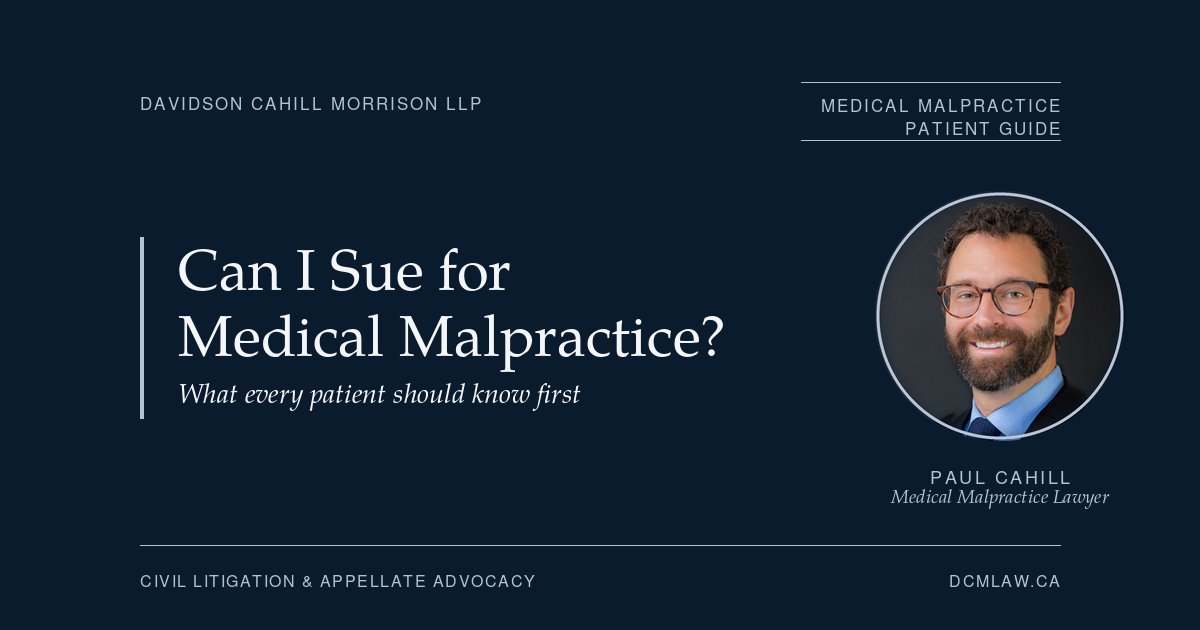
Navy Davidson Cahill Morrison LLP feature card titled "Can I Sue for Medical Malpractice?" with the subhead "What every patient should know first" and a circular headshot of Paul Cahill, Medical Malpractice Lawyer.

Can I Sue for Medical Malpractice in Ontario?

Anyone can start a medical malpractice lawsuit in Ontario, but very few succeed. Drawing on two decades representing patients against doctors and hospitals, Paul Cahill explains what you have to prove, whether a claim actually punishes the doctor, how long you have to sue, what it costs, what it is worth, and how long it takes.

Read More »
Hospital emergency room

Medical Malpractice in the Emergency Room: An Ontario Patient’s Guide

Emergency departments save lives every day, but a missed diagnosis or a delay in urgent treatment can cause devastating harm. This guide explains when an emergency room error becomes medical malpractice in Ontario, what you have to prove, whether the hospital or the physician is responsible, the deadline to sue, and the steps to take if you suspect something went wrong.

Read More »